The history. Shortly after the time of Christ, a group of desert
dwellers developed a new way of life in this area. The Hohokam became
the first farmers in the American Southwest.
Then, as today, irrigation was the key to successful agriculture in the desert.
The Hohokam dug hundreds of miles of canals across the desert, cultivating
corn, beans, squash, cotton, tobacco and other crops. For over thousand years,
this successful agricultural system allowed the Hohokam to build a civilization
covering thousands of aquare miles.
In the late 1300s, the Hohokam gradually abandoned this area. Nobody
knows the reason.
The visit. As you visit the monument and follow the trail you will
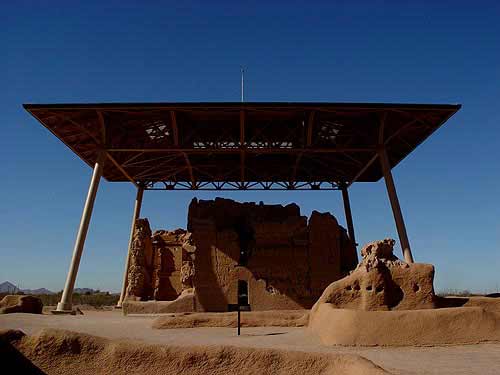
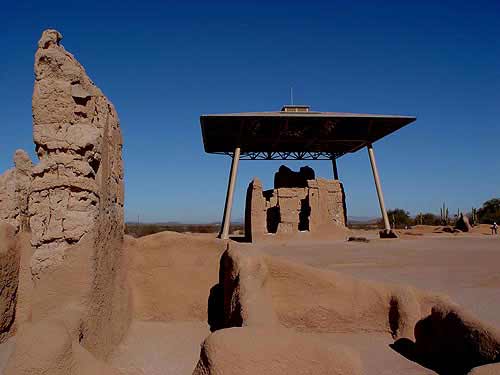
see one of several compounds. The Casa Grande is the best preserved building
and was possible occupied by one large family.
Built in the early 1300s, this building seems to be special. Walk to
the west side of it and you will discover two small holes in the upper part of
the outside wall.
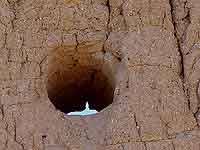
There is a small circular window in the upper left portion. This opening
aligns with the setting sun on the summer solstice (June 21), the longest
day of the year. The square hole in the upper right wall aligns once every
18.5 years with the setting moon at an extreme point in its cycle. Other
windows and doorways also align with the sun or moon at significant times of
the year.
It seems that the Hohokam used a calendar system based on the motions of the
sun and moon. Casa Grande may have served as an astronomical observatory
and calendar.
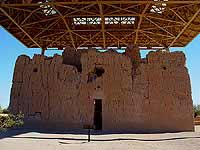
The best preserved west side
of the Casa Grande
The circular window, a part
of an astronomical calendar