The Grand Canyon is believed to be between 3.8 and 6 million years old. The
visible rocks in the bottom of the canyon are close to 2 billion years old
(the rocks gneiss and schist 1.8 billion years), nearly half of the age of
the earth. The rim rocks (Kaibab Limestone) estimated age is
260 million years.
The lower 2000 feet of the Canyon's depth was carved in the last 750 000 years.
The age of the rock Vishnu Schist dates back to a time (late Precambrian era)
when most of Northern Arizona was covered by seas.
Hiking down into the canyon means that each step you make takes you
20 - 30,000 years back into the past, depending on the length of your step.
How was it formed?
The most common theory says that the Colorado River cut down through the rock
of the Kaibab Plateau while the surrounding landscape rose about 70 million
years ago.
How deep is the cut? The elevation change between Yavapai Point on the South
Rim and the Colorado River is 4,600 feet (1400 m).
To learn more about it visit the Visitor Centers (North and South Rim).
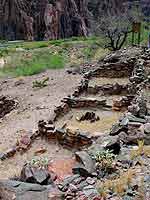
ancestral pueblo site
near Phantom Ranch
Archaeological Sites
Do not remove even the smallest objects from a site - it would damage the
site and change the story it can tell. There are thousends of archaeological
sites within the Grand Canyon National Park.
Since 1979 the Archaeological Resource Protection Act (ARPA) provides
protection of archaeological resources on all public lands. ARPA violations
can result in up to a year in jail and $100,000 in fines for misdemeanor
convictions (for felony convictions up to two years in jail and $250,000 in
fines).
If you see any illegal activity within the park call immediately the
Silent Witness hotline, (928) 638-7767.
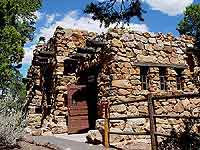
Tusayan Museum
The Tusayan Ruins and Museum are located between Moran and Lipan Point
on Desert View Road.
This prehistoric site is the only excavated ruin on the South Rim. It is
u-shaped with a courtyard and 15 rooms.
It is estimated that people at Tusayan lived there only for a short time
between 1185 and 1225 and is called an Anasazi site; their descendants are the
Hopi and Pueblo Indians.


 If you didn't get to this page through the mainpage ('choose a language')