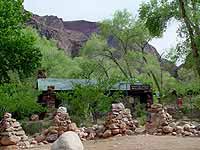
The Phantom Ranch is located at the bottom of the Grand Canyon along the
Bright Angel Creek (just north of the Colorado River) and has long been a
destination for human beings.
History
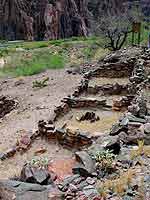
Just south of the ranch (close to the Kaibab Suspension Bridge) you can find
the site of an Indian pueblo.
The ancestral Puebloan people who their descendants, the Hopi, call
Hisatsinum, lived throughout the Grand Canyon for hundreds of years.
This site (dated 1050 - 1140) is a reminder that we are not the first humans
here.
Closer to the Phantom Ranch (just across the campground) you can see a
commercial mule corral. In 1902/03 David Rust began the planting of
fruit trees and cottonwoods and the building of a camp for visitors
at this location - Rust's Camp. It was the first step towards development
of this area and attracted more and more tourists.
After Theodore Roosevelt stayed at the camp in 1913, the name was changed to
Roosevelt's Camp.
In 1922 the Fred Harvey Company commissioned Mary Jane Colter to redesign
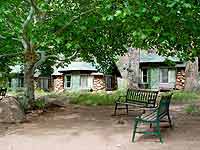
the area. Four (mostly built of stone) of the cabins and the north half of the
lodge are part of the original plan and still can be seen at the ranch.
At that time, Phantom Creek, a tributary of Bright Angel Creek, lent its name
to the new tourist accommodations.
After 1933 the Civilian Conservation Corps (CCC) established a campground
(now the Bright Angel Campground) and some trails, planted cottonwood trees
and expanded and 'updated' the Phantom Ranch.
Present
Today the Phantom Ranch offers over-night staying in cabins and dormatories
for guests, hikers and mule trail users.
Make reservations as far in advance as possible for lodging, meals and
campground - call (303) 29-PARKS or (303) 292 757.
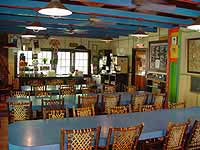
The canteen (the 'little store') of the ranch sells snacks, postcards/stamps,
beer, wine, refreshing drinks and souvenirs (such as the original 'Phantom
Ranch T-shirt') to guests and hikers.


 If you didn't get to this page through the mainpage ('choose a language')